This is a non-promotional website produced and funded by AstraZeneca, intended for UK patients who have been prescribed Calquence ▼ (acalabrutinib).

For UK members of the public, please visit https://www.astrazeneca.co.uk/

My CLL logo
My CLL logo
  • Home
  • Understanding CLL
  • About Calquence
  • Managing my CLL
  • Resources
calquence logoastrazeneca logo
 

Understanding Chronic Lymphocytic Leukaemia (CLL)

Take it step by step - from how it starts, to symptoms, stages and the moment treatment becomes right for you

fixed nav trigger

CLL Overview
Signs and Symptoms of CLL
Stages of CLL
Starting treatment
CLL Overview
Signs and Symptoms of CLL
Stages of CLL
Starting treatment

CLL Overview

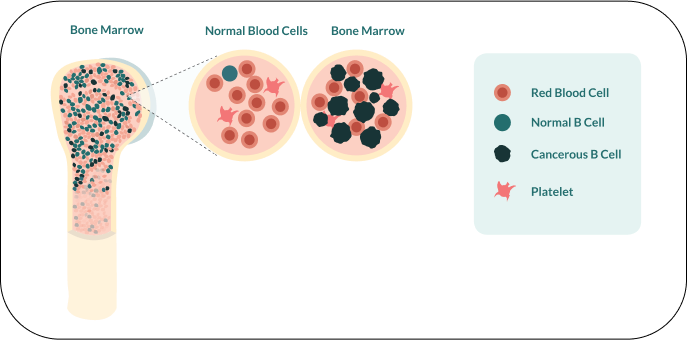
Chronic lymphocytic leukaemia (CLL) is a slow-growing type of blood cancer that starts in B cells, a type of white blood cell that forms in the bone marrow. B cells are released into the bloodstream to help protect your body from infection. However, in CLL, too many abnormal B cells are produced, which crowd out other healthy cells such as red blood cells and platelets. This is what can lead to symptoms like tiredness, frequent infections, or swollen lymph nodes.


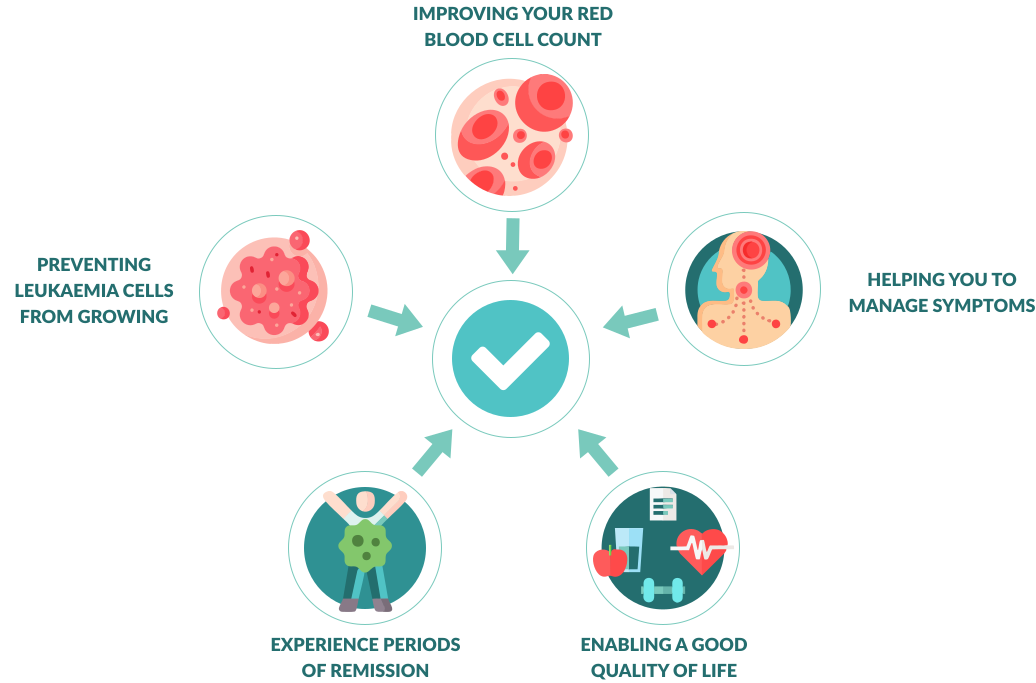
The goals of any treatment for CLL are to reduce these abnormal cells, manage the disease and enable a good quality of life.1,2
Signs and symptoms of CLL:

'Images of different signs and symptoms of CLL 'Images of different signs and symptoms of CLL

  very enlarged or fast-growing lymph nodes3

'Images of different signs and symptoms of CLL 'Images of different signs and symptoms of CLL

a low level of red blood cells (anaemia) or platelets3

'Images of different signs and symptoms of CLL 'Images of different signs and symptoms of CLL

weight loss3

'Images of different signs and symptoms of CLL 'Images of different signs and symptoms of CLL

Fatigue4,5

'Images of different signs and symptoms of CLL 'Images of different signs and symptoms of CLL

 Infection4

'Images of different signs and symptoms of CLL 'Images of different signs and symptoms of CLL

Night Sweats

Stages of CLL

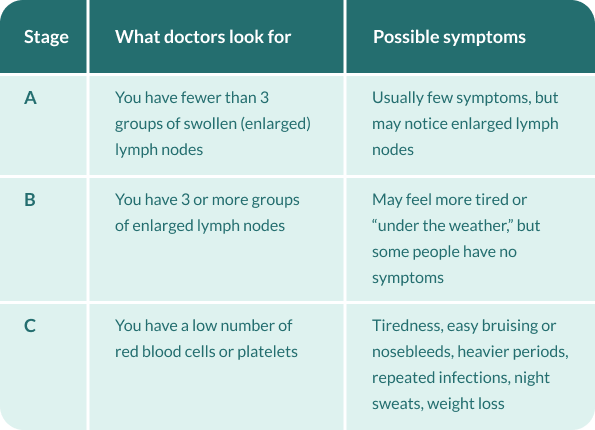
At diagnosis, some people present with few or no symptoms and therefore do not require treatment.1,5 ‘Watch and wait’, also known as ‘active surveillance’, is a way of monitoring patients without initiating active treatment. Following on from this phase, doctors often use three ‘stages’, A, B and C (refer to table), to describe CLL progression and decide on treatment options.1


For staging of CLL, doctors look at:5

  • the number of red blood cells and platelets in your blood
  • how many areas of swollen (enlarged) lymph nodes


The areas of lymph nodes are in your neck, armpit, groin, spleen and liver. Each area counts as one group even if the nodes on both sides of the body are swollen.5


The table shows different stages of CLL along with the symptoms.
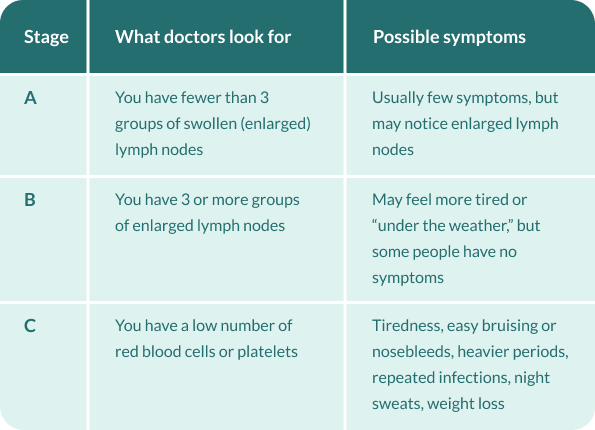
table table


Stages of CLL and associated symptoms
Click on the image to enlarge

Starting Treatment

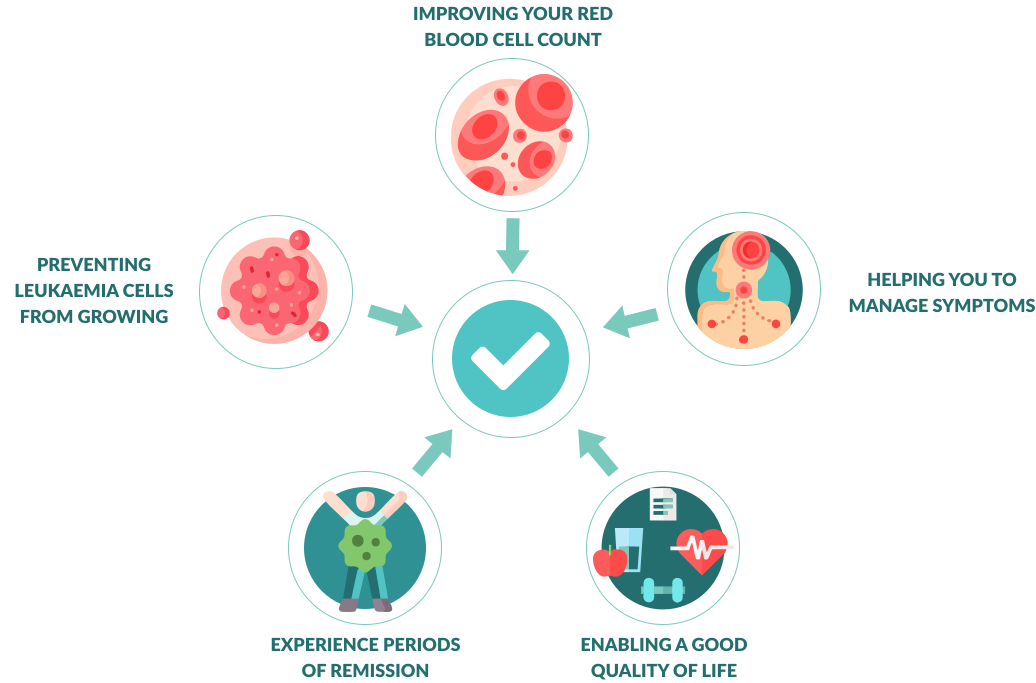
The goals of any treatment for chronic lymphocytic leukaemia (CLL) include:3,6-8
Abbreviations:

CLL, chronic lymphocytic leukaemia

References:

  1. Leukaemia Care. About CLL. [Internet]. Accessed August 2025. Available from https://www.leukaemiacare.org.uk/support-and-information/information-about-blood-cancer/blood-cancer-information/leukaemia/chronic-lymphocytic-leukaemia/about-cll/
  2. CALQUENCE. JUST DIAGNOSED WITH CLL/SLL. Accessed August 2025.
  3. Macmillan Cancer Support. Treatment for chronic lymphocytic leukaemia (CLL). [Internet]. Accessed August 2025. Available from https://www.macmillan.org.uk/cancer-information-and-support/leukaemia/chronic-lymphocytic-leukaemia-cll-treatment
  4. Lymphoma Action UK. Anaemia. [Internet]. Accessed August 2025. Available from: https://lymphoma-action.org.uk/about-lymphoma-side-effects-treatment/anaemia
  5. Cancer Research UK. Staging chronic lymphocytic leukaemia (CLL). Accessed August 2025. Available from https://www.cancerresearchuk.org/about-cancer/chronic-lymphocytic-leukaemia-cll/staging
  6. Blood Cancer United. Chronic Lymphocytic Leukemia (CLL). Available at:https://bloodcancerunited.org/blood-cancer/leukemia/chronic-lymphocytic-leukemia-cll Accessed October 2025
  7. Mukkamalla SKR, Taneja A, Malipeddi D, et al. Chronic Lymphocytic Leukemia. [Updated 2023 Mar 7]. In: StatPearls [Internet]. Treasure Island (FL): StatPearls Publishing; 2025 Jan-. Available from: https://www.ncbi.nlm.nih.gov/books/NBK470433/
  8. Chronic lymphocytic leukaemia (CLL) and small lymphocytic lymphoma (SLL). Leukaemia Care (2024) [Internet]. Accessed August 2025. Available from https://lymphoma-action.org.uk/sites/default/files/media/documents/2024-12/CLLSLLBook_LAComplete.pdf

GB-69341 | August 2025

▼ This medicine is subject to additional monitoring. This will allow quick identification of new safety information, and you can help by reporting any side effects you may get. See below for more information.

Reporting side effects

If you get any side effects, talk to your doctor, nurse or pharmacist. This includes any possible side effects not listed in the Patient Information Leaflet. You can also report side effects directly via the Yellow Card Scheme, website: http://yellowcard.mhra.gov.uk/. By reporting side effects you can help provide more information on the safety of medicines.

Side effects can also be reported to AstraZeneca in the following ways:

Online: https://contactazmedical.astrazeneca.com

Email: Medical.InformationUK@astrazeneca.com

This website is only intended for UK patients who have been prescribed Calquence (Acalabrutinib). It does not replace the Patient Information Leaflet, which can be found in the carton containing your medicine and should be read alongside this information. If you have any questions about your treatment, talk to your healthcare team or refer to the Patient Information Leaflet.


All patient images are for illustrative purposes only.

calquence logo

GB-70342 | September 2025

Privacy Notice Terms and Conditions Cookie Policy Contact Us
astrazeneca logo

Welcome to MyCLL

This website is intended only for UK patients who have been prescribed Calquence▼ (acalabrutinib). This website has been produced and funded by AstraZeneca.


Please select the relevant option:

I am not a UK Calquence patient >